Introduction
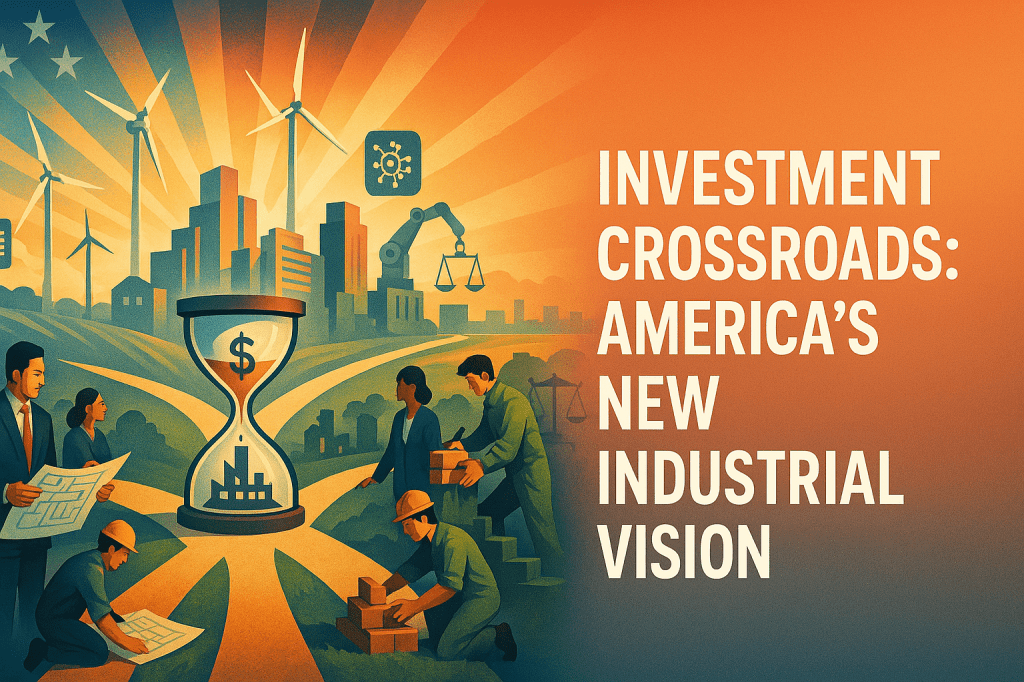
On March 31, 2025, President Donald Trump signed an Executive Order establishing the United States Investment Accelerator, a new federal initiative designed to streamline and accelerate private sector investment in critical American industries. The order creates a coordinated, government-wide approach to attract both domestic and foreign direct investment, with particular focus on semiconductor manufacturing, clean energy infrastructure, artificial intelligence development, and advanced manufacturing. The Executive Order directs the Department of Commerce to lead implementation efforts, with support from Treasury, State, and other relevant agencies. This initiative aims to strengthen America’s competitive position globally while creating high-quality jobs and expanding economic opportunities in underserved communities. The order emphasizes reducing regulatory barriers and coordinating federal resources to maximize investment impact across the United States.
Key Questions for Citizens
- Constitutional Balance: How does this executive order’s approach to industrial policy align with traditional interpretations of federal economic powers, and does it appropriately balance executive authority with congressional oversight of economic development initiatives?
- Regulatory Implications: What safeguards exist to ensure that streamlining investment processes doesn’t circumvent important environmental, labor, or safety regulations that protect public interests?
- Federalism Considerations: How will this federal investment initiative impact state and local authority over economic development, and what mechanisms exist for ensuring cooperative federalism rather than top-down mandates?
- Long-term Governance: What precedent does this order set for future administrations regarding government intervention in private markets, and how might this shift the relationship between government and industry in targeted sectors?
- Equity Analysis: How effectively will the order’s provisions for underserved communities translate to measurable economic benefits, and what metrics will determine success in creating inclusive economic growth?
Analytical Framework
Language Analysis
The executive order employs specific rhetorical strategies that frame its approach and underlying assumptions. The frequent use of terms like “accelerate,” “streamline,” and “unlock” suggests a premise that existing regulatory and administrative processes are obstacles to economic growth. This framing positions government primarily as a facilitator rather than regulator of market activities.
The order consistently employs the language of “competitiveness” and “global leadership,” establishing a normative framework that presupposes international economic competition as a primary national priority. This framing implicitly ranks economic development above other potential policy considerations.
Notably, the text balances this market-oriented language with references to “high-quality jobs,” “sustainable growth,” and “inclusive economic development,” suggesting an attempt to bridge traditional divides between growth-focused and equity-focused economic policies. The juxtaposition of these terms indicates an attempt to appeal to diverse stakeholder interests.
The order’s language around “strategic industries” and “critical supply chains” reflects a growing bipartisan consensus on economic security concerns, departing from previously dominant free-market rhetoric. This shift in terminology signals a more interventionist approach to industrial policy than has been characteristic of executive orders in recent decades.
“The United States must remain the world’s most attractive destination for private investment while ensuring that economic growth benefits all Americans.”
This statement from the order exemplifies how normative language is used to establish both competitive positioning and inclusive growth as simultaneous priorities, though potential tensions between these goals remain unaddressed in the framing.
Evidence Assessment
The executive order references several data points regarding global investment flows, manufacturing capacity gaps, and economic opportunity zones. However, it provides limited specific evidence regarding:
- The actual impact of regulatory barriers on investment decisions, relying more on assertion than empirical analysis
- Comparative data on how similar investment acceleration programs have performed in other countries
- Concrete metrics for measuring success beyond broad economic indicators
The order cites recent supply chain disruptions as justification for the focus on domestic manufacturing capacity, which aligns with consensus expert assessments about vulnerabilities exposed during the pandemic and subsequent global disruptions. However, the causal relationship between regulatory streamlining and supply chain resilience remains asserted rather than empirically established.
The economic claims regarding job creation potential appear to draw from industry projections and Commerce Department economic modeling, though these models often rely on favorable assumptions about multiplier effects that some economists have questioned. The order would benefit from more transparent acknowledgment of the range of expert opinion on projected outcomes.
Legal and Policy Context
This executive order builds upon several preceding policies, including the CHIPS and Science Act, the Infrastructure Investment and Jobs Act, and previous executive actions on supply chain resilience. It operates within the executive branch’s authority to coordinate across agencies but does not appropriate new funding, which remains Congress’s constitutional prerogative.
The order may face implementation challenges in several domains:
- Jurisdictional Complexity: The multiple agencies involved (Commerce, Treasury, State, Labor, Energy) have overlapping but distinct regulatory authorities, potentially creating coordination difficulties.
- Statutory Constraints: Streamlining processes must still comply with requirements from laws like the National Environmental Policy Act, Administrative Procedure Act, and various sector-specific regulations.
- Judicial Review: Courts have increasingly scrutinized executive branch attempts to modify regulatory processes without clear congressional authorization, potentially limiting implementation scope.
The order’s relationship to state and local permitting processes remains particularly ambiguous. While federal agencies can expedite their own processes, many critical investment barriers exist at state and local levels where federal authority is limited. The order acknowledges the need for federal-state coordination but provides limited specific mechanisms beyond creating “regional investment hubs.”
Stakeholder Impact Analysis
Direct Beneficiaries:
- Large manufacturers in targeted sectors (semiconductors, clean energy, AI)
- Construction firms involved in building new facilities
- Communities where new investments are located, particularly in designated opportunity zones
- Investors seeking streamlined regulatory processes for capital deployment
Potential Adverse Impacts:
- Small businesses facing increased competition from larger, subsidized enterprises
- Communities where environmental review processes might be expedited
- Workers in non-targeted industries that may see relative disinvestment
- State agencies whose regulatory authority may be partially superseded
The order’s impacts will likely vary significantly across geographic regions. Areas with existing infrastructure, skilled workforces, and proximity to supply chains stand to benefit disproportionately despite the stated focus on underserved communities. The effectiveness of provisions targeting historically disadvantaged areas remains uncertain without specific resource allocations or enforceable commitments from private sector partners.
An unintended consequence might emerge in the form of “regulatory arbitrage,” where investments flow to regions with the least stringent implementation of remaining regulations. This could potentially undermine the order’s stated commitment to sustainable development if not carefully monitored.
Conclusion
The Executive Order establishing the United States Investment Accelerator represents a significant evolution in federal industrial policy, reflecting growing bipartisan consensus around economic security concerns while maintaining distinctly different emphases on implementation. The initiative promises potential benefits in strengthening domestic manufacturing capacity and creating economic opportunities, but its effectiveness will ultimately depend on implementation details not fully specified in the order itself.
The most noteworthy innovation is the attempt to create a whole-of-government approach to investment facilitation, potentially reducing bureaucratic fragmentation that has historically complicated major infrastructure and manufacturing investments. However, questions remain about how this coordination will translate to measurable outcomes, particularly regarding equity goals and environmental considerations.
As implementation proceeds, policymakers, researchers, and citizens should closely monitor several areas: the geographic distribution of investments, the quality and accessibility of jobs created, the maintenance of critical regulatory safeguards, and the development of transparent metrics for evaluating the program’s overall effectiveness. The ultimate impact of this executive order will depend not just on its text, but on the administrative infrastructure created to implement its vision.
Written by Claude Prompt v1
Image by ChatGPT
 AI American Fork