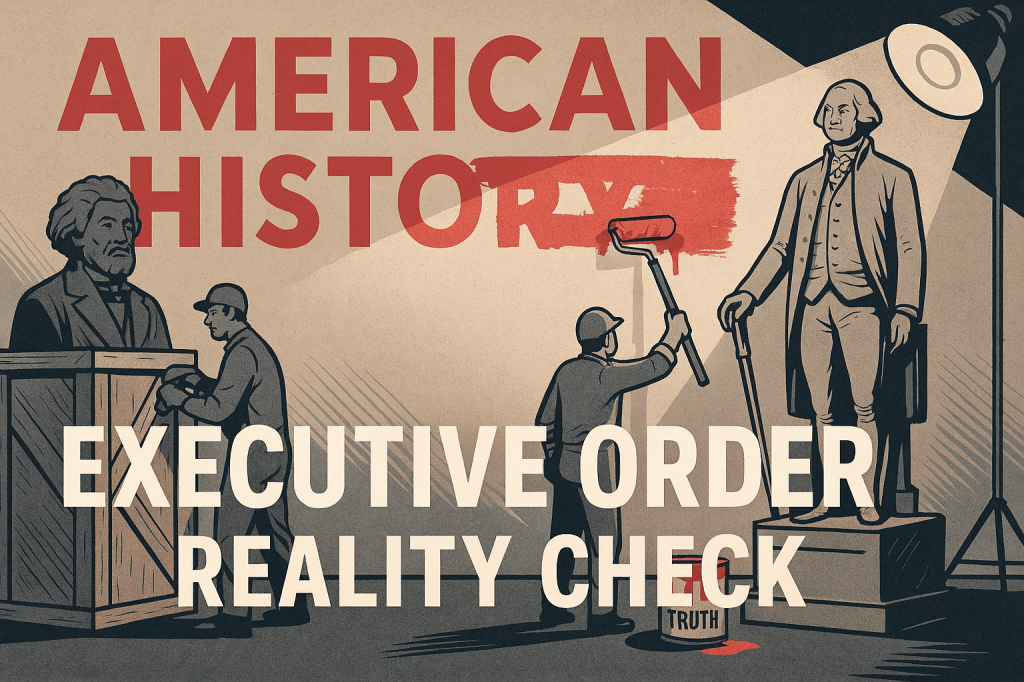
This executive order, issued by President Donald J. Trump, claims to counteract a trend of “revisionist history” that it says distorts America’s legacy by emphasizing racism, oppression, and ideological narratives. It directs federal agencies — including the Department of the Interior and the Smithsonian Institution — to remove content it deems divisive, reinstate historical monuments altered since 2020, and promote a patriotic version of American history that centers on progress, liberty, and greatness. It also explicitly prohibits recognition of transgender individuals in the American Women’s History Museum.
Rhetorical Framing
The order repeatedly uses emotionally charged phrases like “corrosive ideology,” “distorted narrative,” and “irreparably flawed” to describe contemporary historical scholarship. These terms are subjective and undefined, serving to frame opposing views as dangerous or illegitimate rather than engaging with their substance. The phrase “restore truth and sanity” itself implies that current institutions are unhinged — a rhetorical move that creates moral panic rather than measured dialogue.
Unsupported or Misleading Claims
The order refers to specific museum exhibits and training programs (e.g. at Independence Hall or the Smithsonian) without providing citations, documentation, or context. Statements like “the prior administration sponsored training… that pressured rangers to speak based on their race” are serious allegations but are not backed by any verifiable evidence within the order.
Similarly, exhibits that describe race as a social construct — a position supported by genetic science and social science — are dismissed as ideological without explanation. The order paints these mainstream academic perspectives as fringe or harmful without any scholarly rebuttal.
Policy and Legal Implications
This order sets a precedent for politicizing historical institutions. It grants the Vice President the authority to reshape museum content and seeks to appoint ideologically aligned members to the Smithsonian Board of Regents. It also threatens funding for content that “degrades shared American values” — a vague phrase that invites censorship and raises First Amendment concerns.
The mandate to reject trans inclusion in the Women’s History Museum is especially notable: it represents a direct use of federal policy to legislate identity and exclude a group of citizens from national historical representation.
Logical Inconsistencies
The EO assumes that discussing racism, systemic power, or gender identity is inherently “divisive” or anti-American. It draws a false equivalence between critique and disloyalty — suggesting that acknowledging injustice undermines national unity. This framing ignores the possibility that honesty about the past can promote deeper understanding and cohesion.
Summary
This executive order reframes established historical research as ideological extremism, conflates critique with hostility, and asserts federal control over cultural institutions to enforce a singular narrative. It targets inclusion, rewrites representation, and suppresses complexity in favor of mythmaking. It does not defend history — it politicizes it.
Questions for Americans to Consider
- Who should decide what version of history is taught in our public museums — scholars or politicians?
- What are the risks of limiting historical narratives to only positive or patriotic interpretations?
- Does this order reflect a desire for truth, or for control over how truth is defined?
- What does it mean for democracy when federal funding is tied to ideological compliance?
- If history is shaped only by those in power, whose stories are left out?
Prompt Used to Generate this Article
Write a blog post titled “Executive Order Reality Check: Insert Executive Order Title”
- Begin with a neutral summary of the Executive Order’s stated purpose, objectives, and proposed actions. Avoid emotional or judgmental language.
- Provide a fact-based analysis, identifying:
- Rhetorical strategies (e.g., emotionally loaded language, vague generalizations, political labeling)
- Claims lacking evidence or context
- Departures from expert consensus, academic research, or established historical facts
- Policy and legal implications, including censorship, politicization of institutions, or exclusionary impacts
- Logical inconsistencies, such as false causation or overgeneralization
- Use clear subheadings and write in a professional, analytical tone. Avoid sarcasm or partisan phrasing.
- Conclude with a brief, evidence-based summary of the Executive Order’s most significant issues or concerns.
- End the article with 3–5 critical questions that readers should ask themselves about the broader implications of the Executive Order — questions that prompt reflection on democracy, truth, civic responsibility, and historical understanding.
- Lastly, generate a custom visual prompt for a featured editorial-style image that symbolically represents the order’s content and critique. Include mood, symbolism, tone, style, and color suggestions for use with AI image generation tools.
 AI American Fork