Introduction
On March 25, 2025, President Donald Trump signed an Executive Order titled Preserving and Protecting the Integrity of American Elections. This order establishes new federal requirements for electoral processes across the United States, focusing on citizenship verification, ballot reception deadlines, voting system technologies, and enforcement of existing federal election laws. The order directs multiple federal agencies—including the Election Assistance Commission, Department of Homeland Security, Department of Justice, and Social Security Administration—to implement specific measures aimed at preventing non-citizens from voting, enforcing uniform ballot receipt deadlines of Election Day, updating voting system guidelines, and sharing information between federal and state authorities. The stated purpose is to ensure “free, fair, and honest elections unmarred by fraud, errors, or suspicion” which the order deems “fundamental to maintaining our constitutional Republic.”
Key Questions for Citizens
- Federalism Question: How does this executive order realign the balance of power between federal authorities and states in election administration, and what are the constitutional implications given that elections have historically been primarily state-managed?
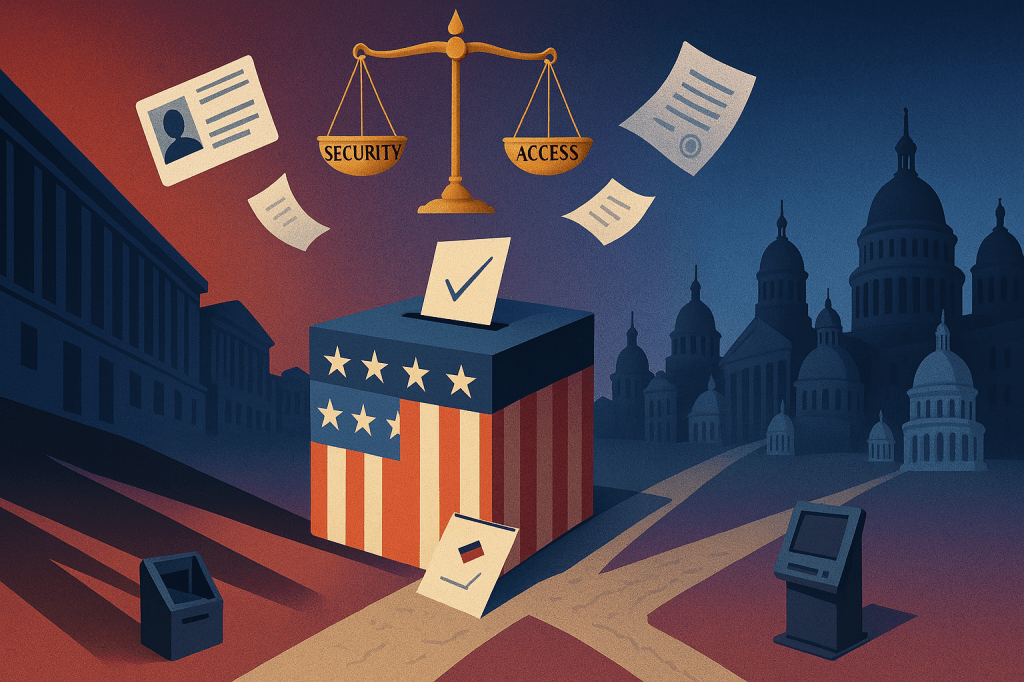
- Access vs. Security Question: How should citizens evaluate the trade-offs between enhancing security measures (like citizenship verification) and potential impacts on voter participation, particularly for underrepresented communities?
- Technological Standards Question: What are the practical and financial implications of rescinding certifications for current voting systems and requiring new technology standards for states and localities that have recently invested in voting equipment?
- Historical Context Question: How do the citizenship verification and uniform ballot receipt requirements compare with past federal interventions in election administration, and what lessons can be drawn from those precedents?
- Funding Question: What financial burdens might states face to implement these requirements, and how might conditional federal funding affect states’ ability to administer elections according to local needs and preferences?
Analytical Framework
Language Analysis
The executive order employs specific rhetorical devices that frame its provisions within a particular narrative about election integrity. The order begins by positioning the United States as lagging behind other nations in election security measures, citing examples from India, Brazil, Germany, and Canada. This comparative framing establishes a presumptive need for reform by suggesting American elections are less secure than those in other countries.
Notable normative language appears throughout, particularly:
“Free, fair, and honest elections unmarred by fraud, errors, or suspicion are fundamental to maintaining our constitutional Republic.”
This statement presupposes that current elections are marred by fraud, errors, or suspicion—an assumption that establishes the need for intervention without directly addressing the empirical evidence regarding the prevalence of such problems.
The order employs definitive language about existing problems:
“Yet numerous States fail to comply with those laws by counting ballots received after Election Day.”
Such statements present contested legal interpretations as settled fact. The order also uses value-laden analogies, such as comparing late-arriving mail ballots to allowing people to vote in person after Election Day, which it characterizes as “absurd.”
Evidence Assessment
The executive order makes several empirical claims that warrant evaluation against available research:
- Claim about non-citizen voting: The order implies widespread non-citizen voting through statements like “States fail adequately to vet voters’ citizenship.” Current research on non-citizen voting suggests extremely low rates of non-citizen participation. A comprehensive 2017 study by the Brennan Center for Justice found incident rates of approximately 0.0001% in states that had conducted investigations.
- Claims about mail ballot vulnerabilities: While the order cites European nations’ limited use of mail ballots as evidence of best practices, it omits that countries like Australia have extensive postal voting systems. Research by the National Academy of Sciences found that all forms of voting, including mail ballots, have very low rates of fraud in the United States.
- Foreign interference: The order references “foreign nationals and non-governmental organizations” taking “advantage of loopholes” to spend “millions of dollars” in elections. While foreign interference in elections has been documented, particularly in social media and information operations, the order provides no specific data quantifying the scale of the problem in the domain of campaign finance.
The executive order selectively references court decisions that support its position (e.g., RNC v. Wetzel) but does not acknowledge conflicting judicial interpretations on issues like ballot receipt deadlines.
Legal and Policy Context
The order intervenes in several areas of election administration with complex legal frameworks:
Mail ballot deadlines: Federal courts have issued conflicting rulings on whether 2 U.S.C. 7 and 3 U.S.C. 1 prohibit counting ballots received after Election Day. Some courts have held that these statutes only set the day of voting, not ballot processing. The Supreme Court has not definitively resolved this question.
Proof of citizenship requirements: Previous attempts to require documentary proof of citizenship for voter registration have faced legal challenges. In Arizona v. Inter Tribal Council of Arizona (2013), the Supreme Court ruled that Arizona could not impose citizenship documentation requirements beyond those in the federal voter registration form. The order attempts to circumvent this precedent by directing the Election Assistance Commission to modify the federal form.
Information sharing: The directive for extensive information sharing between federal agencies and states regarding voter eligibility raises questions under the Privacy Act of 1974 and the Drivers Privacy Protection Act, which limit certain information sharing.
Implementation challenges include:
- The EAC is required to rescind certification of voting systems within 180 days, but local jurisdictions may be contractually bound to existing systems and lack budget resources for rapid replacement.
- The order mandates citizenship verification but does not address how to implement this requirement without disrupting existing registration processes or creating barriers for eligible voters who may lack ready access to the required documentation.
- The directive to withhold federal funds from states that do not comply with specific interpretations of federal law may generate extensive litigation over statutory interpretation.
Stakeholder Impact Analysis
Election officials: State and local election administrators face significant operational challenges, including potential costs for new voting systems, changes to voter registration processes, and requirements to check citizenship status against federal databases.
Voters: Several provisions could affect voter access:
- Documentary proof of citizenship requirements have historically had disparate impacts on Native American, elderly, low-income, and minority voters who are less likely to possess or have ready access to the required documents.
- Uniform ballot receipt deadlines could affect voters in rural areas, military personnel, and others who rely on mail ballot options.
- Voters with disabilities might face impacts from changes to voting systems that currently use barcodes or QR codes as accessibility features.
Federal agencies: The order substantially increases responsibilities for the Department of Homeland Security, Department of Justice, Election Assistance Commission, and Social Security Administration, which will need to allocate resources to implement these directives.
States: States with different approaches to election administration—particularly those with extended ballot receipt windows or limited citizenship verification processes—face potential loss of federal funding and legal challenges if they do not conform to the order’s interpretations of federal law.
Communities with language barriers: The order does not address how citizenship verification processes will accommodate voters covered by language provisions of the Voting Rights Act.
Conclusion
This executive order represents a significant federal intervention in election administration policies traditionally managed primarily by states. The most consequential aspects include the documentary proof of citizenship requirements, the uniform Election Day ballot receipt deadline, the rescinding of voting system certifications, and the conditioning of federal funds on compliance with specific interpretations of federal election laws.
The order reflects a specific perspective on election security that prioritizes preventing potential fraud over concerns about ballot access. It introduces substantial implementation challenges for election officials at all levels and raises important questions about federalism in election administration. The legality of several provisions will likely face court challenges, particularly regarding the EAC’s authority to require documentary proof of citizenship and the interpretation of federal laws regarding Election Day.
Citizens should carefully consider both the stated security benefits and the potential access implications across diverse communities, while recognizing that the practical effects will depend heavily on implementation details and judicial review. Further research is needed on implementation costs, impacts on voter participation rates across demographic groups, and the prevalence of the election security issues the order seeks to address.
Written by Claude Prompt v1
Image by ChatGPT
 AI American Fork